Social Icons

Pages

mardi 8 décembre 2015

Why nations fail ? ... and why companies fail ?


Why nations fail ?

In this very inspiring book, called why nations fail ?, Daron Acemoglu and James Robinson demonstrate with a number of in depth examples that disappeared civilizations have failed because they have not been able to incentivise their citizens in creating value. 

Why Nations Fail cover

Extractive civilizations are the ones where the elites try to extract the larger value from the citizens without giving any thing back. Value is extracted not only through taxes but also in redirecting towards the elites all the possible value, controlling monopolies, not respecting property and in some cases not even respecting the human rights of their citizens. 

In such a context, why should citizens be motivated in putting huge efforts in generating value when this value will be captured by the elite ? 

Among the number of examples brought by the authors to illustrate this theory, one is  fascinating : the Venice republic. This small town has been able within a very short time to expand its influence to whole Mediterranean area and in an even shorter time, they have collapsed completely !

Why ?

The reason why Venice republic has been so successful is that they have invented an inclusive governance in which the citizens were paid back from the efforts they put for generating value. As an example, Venice republic invented the joined venture: a shared model between navigators and merchants was in place to incitivise navigators to explore and trade with remote countries. Back to Venice those successful explorers were getting a reasonable part of the cake and were gaining influence within the city as the governance model was open to new comers. 
This illustrates the creative destruction coined by Joseph Schumpeter. 
Of course, creative destruction comes at the expense of established players and this is the very reason why elites are getting increasingly reluctant to support such an approach. They have climbed the ladder and they don't want to be challenged or even worse to be replaced by new comers.
This is exactly why, after years of success Venice republic failed : governance changes stopped the inclusion of new comers establishing a status quo among the established players. This froze innovation and growth and lead extremely rapidly to the decline.

What about companies ?

A strong parallel can be made with companies which are somehow similar to states : they set up  a governance  model which can be more extractive or more inclusive. Normally when they are small, they favour initiative and growth and tend to be more inclusive. Later, being established, they become extractive, extracting the more value possible from their employees and keeping the status quo as much as possible making them becoming in the end irrelevant. 

This theory about inclusive vs extractive approaches also explains the success of transformational leadership which aims at developing employees instead of only extracting value from them.

vendredi 4 décembre 2015

Goldman Sachs patents blockchain technology for Securities

Securities settlement  is a rather cumbersome process coming from the old days when securities were still materialised. The whole process is still needing some days to complete (between 1 to 3) generating some credit risks in the meanwhile.

Streamlining this process is therefore not only important from an efficiency view point but also from a credit risk perspective. If delivery versus payment is processed immediately,  it will optimise the processing costs and reduce the credit risks.

This is why Goldman Sachs put some efforts and investments in that mater which lead to issuing a patent which has been recently validated.

The idea here is to create a new currency called SETLcoin which will represent any kind of securities (called PIC in the patent). These new coins will be exchanged against other coins like bitcoin.

The patent is describing a coordinator which will ensure the simultaneous completion of the two transaction legs (money against securities).

This reinforces the view BNP Securities has shared in a research paper earlier this year, the securities industry is going to be severely impacted by the blockchain technology. In this paper, BNP presents two possible scenarios : a complete disruption where the market participants trade directly without any central body or a more conservative one where the established actors will embrace blockchain technology.

This patent has been filled something like one year ago and demonstrates how much interest the established actors have for this technology.

Goldman recently confirmed its forecast regarding the disruption blockchain will introduce, this post also shows the amazing investments the blockchain technologies have attracted.

vendredi 27 novembre 2015

Blockchain integration strategy

Blockchain technology is now generating a big hype in particular in financial services and is envisioned as the magic solution to solve all inefficiencies in particular in back-offices processes.

Even though it is true to say that those processes are sub-optimal and that blockchain can bring a lot of optimisations, blockchain should not be considered as a magic stick!

What blockchain and smart contracts will bring functionally is huge :
  • a shared trade representation between the buyer and the seller, short cutting all the tedious reconciliations performed at multiple levels,
  • a full life cycle management of the products through automated contracts and this being shared between the buyer and the seller,
  • a realtime transaction backbone supporting all type of flows (money, securities, contracts, ...)
This will bring a lot of efficiencies only if there is in place a seamless integration of the blockchain ledger with the existing components banks may have.

To illustrate this, let's take an example on a derivative contract.
There, the blockchain could help in many ways:
  • at front-office level, simulating the product with the customer instead of exchanging excel based term-sheets,
  • once the product is fully defined and agreed, blockchain would allow an instantaneous booking, the transaction being signed by both parties (the seller in creating the product and the buyer in buying the product),
  • the code defining the product would allow to generate all the flows for different events all along the lifecycle (coupons, barriers, termination, ...)
  • reporting is also much easier, the transaction database is open and available to any application (even to the regulator ?)
As seen over this high level example, blockchain is impacting all banks' activities from front-office to accounting. Will the promise be delivered if blockchain is implemented as a separate system ? Definitely not!

If not integrated with the existing blocks, it will become a YASR (Yet Another System to Reconcile) bringing some value but creating also additional work to maintain its consistency with the existing blocks. Therefore, beside the tests banks are now conducting, before moving on further steps banks should consider the integration path with existing systems : accounting, market data, back and front office not forgetting risks and reporting.

Without those mandatory steps the full blockchain power will not be released!

samedi 19 septembre 2015

Beyond bitcoin


As seen in the previous post, the Bitcoin technology is expanding since a few years beyond bitcoin it self.

More coins to start with ...


The first area of expansion has been in the crypto currency field : many other alternative currencies have been created such as Ripple, Litecoin to address specific needs like faster confirmations, lighter mining, … Those are still only currencies and there are hundreds of those mostly derived from bitcoin and litecoin, bitcoin being by far the one capturing the highest value. They differ mainly in terms of :
• Monetary policy
• Proof of Work / consensus mechanism

And then something more ...


Then came up the idea of using the bitcoin network for other assets than currencies. For this have been created the meta coins like Colored coins (painting a coin to express that it represents something different of a bitcoin) and Master coins
As said by the bitcoin inventor Satoshi Nakamoto, the bitcoin infrastructure is able of transacting other assets than currencies. Historically, the first one has been the Namecoin to manage dns like domain names.Then this concept has been extended to a large range of contracts such as market transactions. This is what is called blockchain v2

And finally everything in the blockchain !


Starting from there, ideas are blooming to use this infrastructure for a number of other domains touching intellectual property, notary, electronic id and even government topics like votes. This is what is called blockchain v3

Blockchain v2


Blockchain V2.0 is aiming to handle contracts and not only currencies. The development in this area is rather recent starting mostly in 2014

The main idea is to use the blockchain infrastructure to store any kind of contract on any asset transacted directly between two parties. This is bringing a generalization of the concept and hurting directly a number of market actors which are providing trust to the two counterparts of a transaction (Exchanges, Clearers, Custodians, …) As listed the technology can be used in a number of fields like :

• Financial transactions
• Public records
• Private records
• Attestations
• Physical asset keys
• Intangable assets like patents, trademarks

Financial transaction are quite close to currencies, the goal is there to trade an other type of asset. For records and attestations the goal is a little different for example your insurance company, instead of sending you a letter to prove that you are insured will send you as a blockchain transaction a proof that you own a contract. This can be reuse to attest that you own the contract you pretend owning.

DAC are companies that operate in a decentralized manner like SETI@home does for years, distributing tasks automatically to lots of agents. Distributed applications like blockchain are a first step in this direction : different mining companies operate the same application contributing to the blockchain infrastructure and earning transaction fees for doing this work.

Get rid of the man in the middle!


People say sometimes that blockchain is going to kill banks. This is not so sure, in their core business which is managing risk, all these technologies will help banks to increase efficiency. Some businesses (the man in the middle) will disappear and banks will have to adapt to this new landscape but for example risk transformation they perform will remain.

Ripple is offering connectivity between participants for clearing transactions directly. This is avoiding, for smaller banks the cost of correspondent banks to access the market. Fidor is one example of such a customer.

Ripple is currently pushing the concept further developing a smart contract stored in the blockchain. A smart contract is based on a Specific Domain Language which describes the terms of the transaction. This language can then dynamically alter the contract if some events are triggered. For example if a date or a market level is reached.

Ethereum is developing a full Turing machine on the top of Blockchain. This allows to build smart contracts that will be run in a distributed way and as for miners, the companies running the contract scripts will be rewarded. First version of this platform has been released in July

Bitshares on top of a smart contract technology is building a decentralized asset exchange which is going to be live next month. This exchange also provides the collateral mechanisms securing the transactions among participants

Crowdfunding can also be impacted : funders could directly transact with the company they would like to fund. Swarm for example is bringing crowd funding on blockchain.

All these examples clearlly show the trend we are heading for : connect directly counterparts together, getting rid of the man in the middle.

bitcoin or Bitcoin ?

This weird question is hiding a huge trend : the blockchain revolution. To be a little less cryptic, bitcoin comes in two flavours: a crypto currency (bitcoin) and the technology supporting it (Bitcoin). This is not only a little detail : the technology created for the bitcoin currency can be used for many other purposes and this is waht has been called blockchain v2 (and v3).

Under the hood, bitcoin is made of 3 elements :


The currency itself is only one of those components and the two others are the technology building the bitcoin system. The secured and open transaction database which is the heart of the bitcoin system is called blockchain. Because it stores transactions which appear to be on bitcoin but could be on any other asset, this technology is very attractive and reused in a number of projects under the banner blockchain v2.
The protocol is a peer to peer protocol used to connect all the bitcoin nodes together (remember that bicoin is a distributed system to be resistant to attacks).

What is all this technology bringing ?

Double spending

The Blockchain technology is solving the double spending issue which a very common issue even in the real world : how to avoid that a person is selling twice the same good ? We also face this problem through counterfeit money which is another type of double spending.
This issue is aggravated in an electronic world where everything can be copied infinitely.
Bitcoin infrastructure addresses this issue with the blockchain which validates the transactions in the mining process. All the valid transactions are confirmed by the bitcoin infrastructure and sends back unspent transactions output which are reflecting the new position.

Ensure trust


Trust is also a key issue over an insecure media such as internet. Messages exchange has to be reliable and secure. This is achieved through a peer 2 peer network which is less sensitive to attacks than any centralized architecture. The distribution is a key feature to ensure trust as all nodes run independently. Cryptography is also extensively used to protect content and ensure trust, making sure that sensitive content is not disclosed and that participants have clearly the rights they pretend.

Bring resilience


The distributed architecture not only makes the network more resilient it also avoids to centralize all the information in one location which could be more vulnerable to attacks, releasing sensitive personal data : no more honeypots so attractive to hackers! This is also making the system invulnerable to governments censorship.
The distributed architecture has been built not only to be more resilient to any kind of attack but also to avoid the man in the middle. In traditional processes, trust is ensured by a trusted body (state, central bank, exchange, ...) and transactions are flowing through this body which ensures trusts between counterparts. The blockchain technology brings this level of trust without any man in the middle which will have a huge impact on costs. Ripple which is, among other things, a money transfer agent is often viewed as the “Napster of payment”. It will have the same impact on Financial Services as Napster had on the majors of the music industry .

dimanche 2 août 2015

The fintech arena

Fintech is a term describing companies combining technology and finance. It often relates to small startups which bring to the market innovative technical solutions. Over the last years, those fintechs have been developing a blooming offer of financial services that are not available from banks. Banks are now facing a competition coming mostly from those technology driven providers

The services fintechs provide are, for the time being, focusing on simple and standardized products which are not knowledge intensive and that are not generating the biggest margins. They also try to focus on products that are not regulated too much or take advantage of grey areas in the regulation, not requesting banking licenses. This phenomenon has been growing steadily over the last years in particular in the US and in the UK.


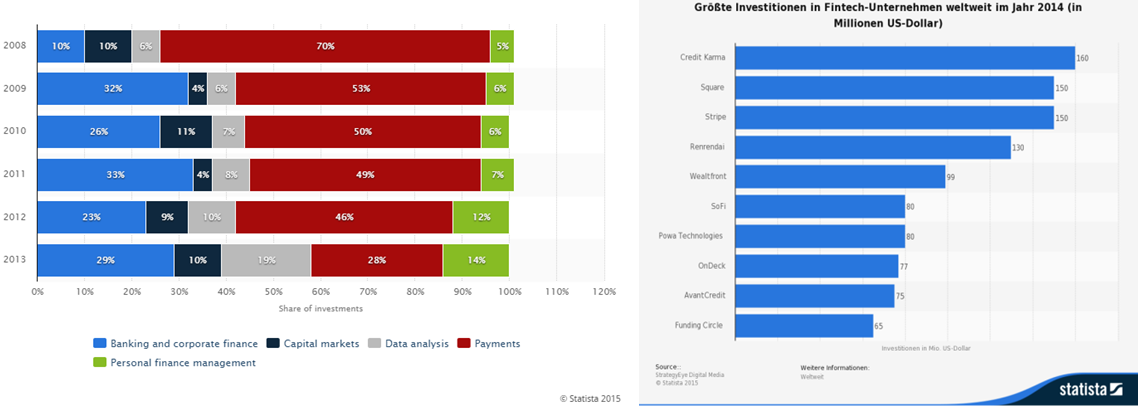
Volumes going through fintech companies grew from 487M€ in 2012 to almost 3B€ in 2014. Regarding investments, 3B€ have been invested in fintechs in 2014 and the forecast for 2015 is to triple, reaching more than 12B€. The number of VC involved and the amount invested are increasing quickly: 520M€ in 2010 up to 2,8B€ in 2014 invested by 55 VCs in 2010 and 216 VCs in 2014 (Source Statisca). Those VCs are predominantly coming from the US and Asia is lagging a bit behind: in 2014, 1.8B€ from the US, 569M€ from Europe and 330M€ from Asia (Source Statisca).
Fintechs have been initially addressing the easiest segment: payments and they are gradually expanding to all segments in particular banking and corporate finance which has been developing significantly:


This growth is surfing on the banks’ lack of innovation in particular regarding digital products. New comers are bringing up to date technology to the market in particular in the real time area where banks are far away. Banks’ technology is sometimes more than 40 years old and mostly based on mainframe technology working in batches. Hardly anything is real time, most actions and events are taken into account the day after. Customers are now used to internet and the real time capacity it offers. Even if banks have invested a lot in online banking it still suffers from the batch mode impacting the user experience.

New entrants are not only startups but also big established internet companies like Apple with the payment service Apple Pay, Google with an equivalent service named Google Wallet, the telcos like Orange which has a banking license and will enter the market in 2016. Those companies have a huge technological capacity and they already own customers. Furthermore, there are, at least for some of them, managing the hardware customers are using: they can manage an end to end user experience from the device to the service. What happened in the media industry is summarized by this quote from Jeff Bezos, Amazon’s CEO: “We are not building devices for technology freaks. We are building devices for people who like to consume and use media. We don't want to make money on the devices, we sell them at cost price and hope that we then make money from the Amazon offering that is linked to the devices. That is films, books, newspapers, games and apps.”. Those technology players are in a good position to offer a great user experience.
Another example is Facebook which just introduced micro payments within members. With 1.4 Billion users including shops, restaurants, Facebook could withdraw a lot of transactions from the regular banking system.

Another strong point of those new entrants is their capacity to analyze data, including personal data, using up to date technologies (Big data). This gives to fintech companies the ability to offer more targeted services to customers or profile their customers better and quicker.
Those companies tend to integrate better in the whole chain. For example payment services provided by fintechs are without much effort integrable in any web or mobile site. This is a differentiating factor compared to banks which have most often much less efficient technologies. For the company owning the web or mobile app, it is beneficial to have a seamless integration at an affordable cost.
But as seen earlier, payments is not the only market fintechs are looking at. The main fintech categories so far are (source Statisca): Payments, Banking and corporate finance, Capital markets, Data analysis, Personal finance management
Inside those categories there are a lot of different types of activities. Banking and corporate finance includes peer to peer lending (consumer or/and business), crowdfunding (reward based or Equity based), community shares (lending small sum to small businesses), invoice trading just to name a few.
Data analysis is an interesting emerging category were fintechs collect financial data on individuals, markets or corporate in order analyze this data in a more efficient way using up to date technologies to analyze huge amount of data. They often use machine learning capacities to bring differentiating capabilities to the market. Examples of this are credit risk scoring or insurance data analytics.
Fintechs in the Capital markets area are more software vendors than true service providers. The knowledge is more important in that area and capital needs are huge.
Personal finance management has been developing a lot including areas like Wealth management and tools to visualize and aggregate all personal banking information in an easy and comfortable way.


As mentioned earlier, fintechs are attacking banks in different point of their value chain. Together they have a large coverage of the products than can be automated. Their capacity to move on more knowledge based products remains to be seen. But their current scope can be already harmful for banks

dimanche 5 juillet 2015

Why App stores for banks ?

App store for banks is nowadays becoming very fashionable and trendy. Bundling banks' services through an API is either done by the bank itself (BNY for example) or by fintechs connecting to different banks (PlaidOpen Bank Project, .. just to name a few).

But behind the hype, there are sound reasons for banks to develop in this direction. As banking is not the only industry making this move, there is already a bit of research backing this strategy.


Banks have to face an ever increasing competition from fintechs. In that context, it is interesting to have a look at what has already been researched in the field of organic growth and innovation within large companies.


Innovation normally occurs in a corporate model for established companies and in an entrepreneurship model for startups. Those two models have a lot of similarities (Engel,2007). In order to more efficiently compete with new entrants, established players are looking at a mix of those two models called: ”corporate entrepreneurship” which is: “the process by which teams within an established company conceive, foster, launch and manage a new business that is distinct from the parent company but leverages the parent’s assets, market position, capabilities or other resources” (Wolcott & Lippitz, 2007)
In this research, the authors identify four models to organize corporate entrepreneurship depending on two dimensions: who, within the organization, has ownership of new business creation and who is funding the needed resources:
©Wolcott & Lippitz

Enabler model 

In the “Enabler” model, the company needs to have a strong base of “intrapreneurs“ who are able and willing to build new ideas and products. This needs to be implemented over time having a strong hiring process making sure that employees have a real entrepreneurial spirit.

Producer model

The “Producer” model can be set up independently from the existing teams but needs a lot of capital and full binding from top management. It also lacks support from the existing business lines with which the producer department may be felt to compete.

Advocate model

The “Advocate” model is probably easier to set up but requires highly trained individuals able to evangelize the whole company triggering the finding from the business lines.

Uncertainty

But what matters most as shown in this research as well as many others is the ability to face uncertainty: “In the early stages, all innovations are defined by uncertainty. If no uncertainty exists, then an organization is simply not innovating.” (Wolcott & Lippitz, 2007). This clearly connected with the learning process Ries is describing in "Lean startup" and also by Breuer : “If venturing is understood as a learning experience, pacing progress with suitable milestones, and sustaining passion become a constitutive moment in self-directed team learning.” 

Facing uncertainty is an issue for established players which have been spending a lot of efforts in cutting costs, optimizing their processes to minimize failure and maximize certainty 


Referring to the four corporate entrepreneurship models, it may seem easier for institutions to adopt a “Producer” model which is requiring a lot of capital but less diffuse involvement in the company.

But from an absorption capacity view point, this kind of setup tends to be less efficient: “A difficulty may emerge under conditions of rapid and uncertain technical change, however, when this interface function is centralized.” (Cohen & Levinthal, 1990). Centralizing in a group the connection to external knowledge may not give all the possibilities an extended communication throughout the company may provide.


On top of corporate entrepreneurship, companies can also access new knowledge interacting with startups (Weiblen & Chesbrough, 2015). For this, they need to screen more than before those startups to identify sources of external knowledge. They also need to understand what they can bring to these startups and finally they need to be clear about their expectation from their collaboration with startups. 

Research is highlighting four possible models of interactions between large companies and startups:


  • Venture capital, taking a stake in a startup; 
  • In-out corporate incubation, where the big corporate act as an incubator for its own ideas but not fitting the core business model; 
  • Out-in corporate incubation where big corporate identify some promising startups which they incubate; 
  • Inside-out platform where large companies setup a platform with their technology, welcoming startups to contribute in building a full ecosystem (Apple iPhone platform is one example of this approach). 

The first two models involve capital sharing whereas the two others do not. A capitalistic relationship can be an issue for both parties: having a stake of a startup bought by a bank can help bringing resources and customers but it can also limit the startup’s freedom to collaborate with competitors. For the banks, it mobilizes capital and the negotiations are sometimes difficult regarding the price as there are numerous unknowns to valuate properly startups.


Exploring the two last models, the out-in model is pretty unlikely and limited considering the very low R&D efforts within banks.

The Inside-out model is the clear trend those days, where many banks are trying to present an API of their systems in order to develop an eco system on top of their services like Apple and Google did with their smartphone technologies. This approach is also fitting with the "Producer" intrapreneurship model which is quicker to implement for companies like banks that have no innovation culture.

This analysis is supporting the trend seen in many organizations where a dedicated department ("Producer" model) is in charge of building an API and relationships with outsiders in order to build an eco system (Inside-out platform) and increase innovation grabbing knowledge from the startups banks interact with.